The $47,000 Problem Sitting Empty Behind Your East Texas Restaurant
Walk down Brick Street in Nacogdoches any July afternoon and you’ll see the same scene repeated at every restaurant: gorgeous outdoor patios sitting completely empty while customers pack inside, waiting 45 minutes for a table. Your patio represents 25-40% of your total seating capacity, and from May through September, it might as well not exist.
Here’s the math that keeps East Texas restaurant owners up at night. The average restaurant patio seat generates $47 per hour during peak service (Source: National Restaurant Association, 2023). If you have 20 patio seats unusable for 5 months, you’re looking at approximately $47,000 in lost revenue annually—money walking out your door because surface temperatures on unshaded patios in Tyler regularly exceed 140°F during summer afternoons (Source: Texas A&M AgriLife Extension, 2022).
This isn’t a residential shade article. You won’t find tips about backyard pergolas here. This is specifically for East Texas business owners—restaurant operators, brewery taproom managers, café owners around Tyler Square, and strip mall business operators in Longview—who need commercial-grade solutions that handle high traffic, meet code requirements, and actually solve the heat problem.
Why Residential Shade Products Fail Commercial East Texas Applications
The Load Factor Most Installers Ignore
Your customers lean on structures. Staff bump into posts while carrying trays. Wind loads during East Texas thunderstorms—which average 52 days annually with sustained winds over 25 mph (Source: National Weather Service Shreveport Office, 2023)—stress mounting points that residential products simply aren’t engineered to handle.
Commercial patio shades for East Texas restaurants require:
- Wind load ratings of 90+ mph to meet Texas commercial building codes
- Fire-retardant fabrics meeting NFPA 701 standards for public assembly spaces
- Heavy-gauge aluminum or steel frames rated for continuous public use
- UV protection exceeding 95% to actually drop perceived temperatures
- Mounting systems compatible with historic brick storefronts common in Downtown Tyler and Historic Kilgore
The downtown brick buildings around Tyler Square present specific challenges. Many were constructed in the 1920s-1940s with lime mortar that crumbles under modern expansion anchors. A commercial shade installation company familiar with East Texas architecture knows to use through-bolt connections or freestanding weighted systems rather than destroying your historic façade.
Oncor Electric Coordination Requirements
If your patio sits near overhead service lines—common in strip mall configurations throughout Longview—your commercial shade installation requires coordination with Oncor Electric for clearance verification. This isn’t optional. Oncor requires minimum 10-foot clearances from service drops, and a permit-pulling commercial installer handles this coordination as standard practice.
Commercial Shade Solutions Ranked by East Texas Restaurant ROI
Not every shade solution makes financial sense for every application. Here’s an honest breakdown based on typical East Texas commercial installations:
| Solution Type | Installed Cost (20-seat patio) | Temperature Reduction | Lifespan | Best Application |
|---|---|---|---|---|
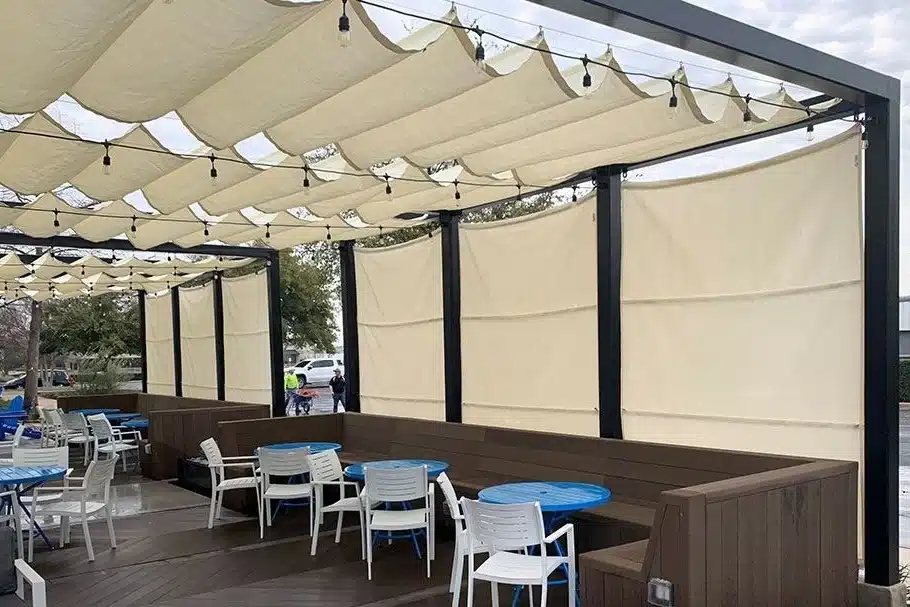
| Motorized Retractable Awnings | $12,000-$25,000 | 15-20°F | 10-15 years | Downtown Tyler storefronts with limited sidewalk depth |
| Tensioned Shade Sails | $8,000-$18,000 | 12-18°F | 8-12 years | Brewery taprooms, casual dining with open aesthetic |
| Louvered Pergola Systems | $25,000-$45,000 | 20-25°F | 20+ years | High-end restaurants, permanent outdoor dining commitment |
| Fixed Commercial Canopies | $15,000-$30,000 | 18-22°F | 15-20 years | Strip mall patios in Longview, freestanding restaurants |
The temperature reductions listed above translate directly to customer comfort thresholds. Research from Cornell University’s School of Hotel Administration found that outdoor dining satisfaction drops 23% for every 5°F above 85°F perceived temperature (Source: Cornell Hospitality Quarterly, 2021). A properly engineered shade system dropping your patio from 105°F to 82°F moves you from “unusable” to “preferred seating.”
The SFA Campus Dining Opportunity
Restaurants near SFA campus dining areas in Nacogdoches face a unique situation. You have 13,000+ students returning every August, precisely when unshaded patios are most brutal. The establishments along Brick Street Nacogdoches that have invested in commercial shade solutions report capturing significant lunch traffic that previously drove to air-conditioned chain restaurants on North Street.
Installation Realities for East Texas Commercial Properties
Historic District Considerations
If your restaurant operates in Historic Kilgore or the downtown core around Tyler Square, your shade installation may require Historic Preservation Board review. This typically adds 3-4 weeks to your project timeline but isn’t the obstacle many owners fear. Boards generally approve shade structures that:
- Don’t permanently alter the historic façade
- Use colors complementing the existing architecture
- Maintain sightlines to architectural details
- Can be removed without structural damage
Freestanding louvered systems and properly anchored shade sails typically sail through approval because they meet all four criteria.
The May Installation Deadline
Here’s the timeline reality East Texas restaurant owners need to understand: if you want your commercial patio shades operational before the May heat hits, you need to begin the process in February. A typical commercial installation timeline looks like this:
- Weeks 1-2: Site assessment and engineering review
- Weeks 3-4: Permit application and historic review (if applicable)
- Weeks 5-8: Custom fabrication (commercial shade structures aren’t off-the-shelf)
- Weeks 9-10: Installation and Oncor coordination
- Week 11: Final inspection and staff training on motorized systems
Waiting until April means you’re installing in June—missing the entire Memorial Day weekend rush and the first month of summer patio season.
What East Texas Business Owners Report After Installation
“We tracked our patio covers for three months before and after installing the louvered system. June through August, our outdoor seating went from 12% utilization to 67%. That’s not a vague improvement—that’s an additional $31,000 in revenue during our slowest inside-seating months.”
— Marcus T., Downtown Tyler, Italian restaurant owner, 24-seat patio with motorized louvered pergola
The financial case becomes even stronger when you factor in reduced HVAC costs. Shaded windows and entrances lower solar heat gain, which multiple Tyler restaurant operators report has reduced their Oncor Electric bills by 8-15% during summer months.
“I was skeptical about the ROI projections, honestly. But our patio went from a liability—customers actually complained about walking past it to get inside—to our most requested seating area. We added a 6-top and a 4-top because the shaded space felt so much larger.”
— Jennifer M., Brick Street Nacogdoches, café owner near SFA campus, tensioned sail system
Comparing Commercial Shade Installation Approaches
General Contractors vs. Shade Specialists
Your general contractor can technically install a shade structure. But commercial patio shades require specific expertise that general contractors typically lack:
- Fabric tensioning knowledge—improper tensioning causes pooling, flapping, and premature failure
- Wind load calculations specific to canopy and sail geometries
- Motorization integration with wind sensors and rain sensors
- Warranty preservation—manufacturer warranties often void with non-certified installation
The 2-3% cost difference between a general contractor and a shade specialist typically costs far more in warranty claims and premature replacements.
Material Selection for East Texas Humidity
East Texas averages 78% relative humidity during summer months (Source: NOAA Regional Climate Center, 2023). This eliminates certain shade fabric options that work perfectly in dry climates:
Avoid: Cotton canvas, untreated polyester, natural fiber blends
Specify: Solution-dyed acrylic (Sunbrella or equivalent), HDPE knitted fabrics, PVC-coated polyester
The mold and mildew resistance of your fabric selection directly impacts maintenance costs. Solution-dyed acrylics maintain appearance with simple soap-and-water cleaning, while inferior fabrics require pressure washing and antimicrobial treatments multiple times per season.
Your Commercial Shade Assessment: What to Expect
A proper commercial shade assessment for your East Texas restaurant or business isn’t a 15-minute visit with a tape measure. Expect a thorough evaluation covering:
- Sun angle analysis for your specific orientation (south-facing patios require different solutions than west-facing)
- Structural evaluation of mounting surfaces—critical for Downtown Tyler’s historic brick buildings
- Utility clearance verification and Oncor Electric coordination requirements
- Permit pathway identification based on your jurisdiction
- ROI modeling based on your current patio utilization and seating capacity
This assessment should be free, comprehensive, and pressure-free. You’re making a $15,000-$45,000 decision that affects your business for the next 15+ years—you deserve complete information before committing.
Request your commercial shade assessment today and get the site-specific engineering data you need to make an informed decision. With the May heat approaching faster than most East Texas restaurant owners realize, the installation timeline starts now.
Whether you’re operating on Tyler Square, managing a taproom in Longview, or running a café near the SFA campus dining corridor, your patio represents significant untapped revenue. Commercial-grade shade solutions engineered for East Texas conditions can transform that dead space into your most profitable seating area.
Schedule your free commercial shade assessment and discover exactly what solution fits your property, your budget, and your revenue goals.
Frequently Asked Questions
How long does a commercial patio shade installation take in East Texas?
Most commercial installations require 9-11 weeks from initial assessment to completion. This timeline includes engineering review, permit processing, custom fabrication of commercial-grade components, and coordination with Oncor Electric if overhead utilities are present. Historic district locations in Downtown Tyler or Historic Kilgore may add 3-4 weeks for preservation board review. Planning for a May operational date means starting the process in February.
What wind rating do commercial patio shades need to meet Texas building codes?
Texas commercial building codes require shade structures in public assembly spaces to withstand minimum 90 mph wind loads. This rating ensures the structure survives severe thunderstorms common to East Texas, which experiences an average of 52 days annually with sustained winds exceeding 25 mph. Residential-grade products typically rate for only 60-70 mph and will fail code inspection for commercial restaurant applications.
Can commercial shade structures attach to historic brick buildings in Tyler or Kilgore?
Yes, but installation methods differ significantly from modern construction. Historic East Texas brick buildings often use lime mortar that crumbles under modern expansion anchors. Qualified commercial installers use through-bolt connections that distribute load across larger areas, or specify freestanding weighted systems that don’t touch the historic façade at all. Both approaches typically receive Historic Preservation Board approval when colors and sightlines respect the original architecture.
What is the typical ROI timeline for commercial patio shade installation at an East Texas restaurant?
Most East Texas restaurant owners report recovering their investment within 18-30 months based on increased patio utilization. A 20-seat patio generating $47 per seat-hour during peak service that moves from 12% to 65% summer utilization represents approximately $35,000-$50,000 in additional annual revenue. Secondary savings from reduced HVAC loads typically add another 8-15% reduction in summer Oncor Electric bills.